


is 25mbps internet speed enough household

Is 25Mbps Internet Speed Enough?

A practical Australian guide to streaming, gaming, video calls, working from home and choosing the right NBN speed tier

Is 25Mbps Internet Speed Enough for Your Household?

A 25Mbps internet speed sits in the practical middle ground between basic connectivity and the faster plans now common across Australia. It is capable of much more than email and web browsing, yet it can feel restrictive when several people, televisions, laptops, consoles and smart devices compete for the same connection.
The key point is that 25Mbps is shared across the whole home. It is not 25Mbps for each person or device. One activity may work perfectly on its own, while the same activity may buffer or lose quality when another person starts a download, joins a video meeting or streams in 4K.

What Does 25Mbps Internet Speed Actually Mean?

1. Your Wi-Fi signal is weak where you actually use it

Mbps stands for megabits per second. It is a measure of how quickly data travels from the internet to your devices. A 25Mbps plan delivers a maximum download speed of 25 megabits per second at any given moment.
To put that in everyday terms: downloading a 1GB file at 25Mbps takes roughly five to six minutes. Streaming a standard definition video takes around 1–3Mbps. A 4K Ultra HD stream from Netflix requires 15–25Mbps on its own. That means one 4K stream can use your entire 25Mbps connection. The challenge is that most households do not use the internet one task at a time. Every device connected to your network draws from that same 25Mbps pool. When two people are streaming at the same time, a third is video calling, and a fourth is downloading files, 25Mbps internet speed may not stretch far enough.
Mbps means megabits per second. It measures how much data an internet connection can transfer each second. A 25Mbps service has a theoretical maximum download rate of approximately 3.125 megabytes per second (MB/s), because one byte contains eight bits. In perfect conditions, a 1GB file could take roughly five to six minutes to download, while a 10GB game update could take close to an hour. Real-world downloads usually take longer because speed varies and files include delivery overheads.
Download speed affects streaming, loading websites and receiving files. Upload speed affects sending files, cloud backups, livestreaming and how clearly your video is transmitted during a call. Latency, jitter and packet loss also matter. A speed test can show 25Mbps while poor Wi-Fi or unstable latency still makes gaming and video calls feel rough.

How Many Devices Can 25Mbps Support?

There is no honest fixed device number because connected devices do not all use the internet in the same way. Ten idle smart-home devices may consume almost nothing, while one 4K television can use most of the available speed. The better question is how many demanding activities happen at the same time.
For a one- or two-person household, 25Mbps can be a sensible choice when usage is moderate. It becomes less comfortable for families with several simultaneous streams, regular large downloads, multiple remote workers or extensive cloud-connected equipment. NBN guidance also notes that more devices create greater demand and that busy households may benefit from a faster plan and a capable router.
Household activity Likely experience on 25Mbps Main pressure point
Browsing, email and social media Comfortable for several devices Usually Wi-Fi coverage, not plan speed
One HD stream plus light browsing Comfortable Little concern in normal conditions
One 4K stream plus phones Usually workable Limited spare capacity
Gaming plus one HD stream Usually workable Latency and game downloads
Two HD video calls Possible with a stable connection Upload speed and Wi-Fi
Multiple 4K streams or large downloads Likely constrained Total shared bandwidth

25Mbps Compared With Other Internet Speed Tiers

Choosing a speed tier is easier when the options are compared against real household behaviour. The table below is a practical guide rather than a guarantee. Actual speed depends on the access technology, provider performance, network congestion, router, Wi-Fi coverage, wiring and device capability.
Speed tier Typical household fit Common activities Where it can struggle
12Mbps One light user Email, browsing, social media, one modest stream Multiple users, HD calls and large downloads
25Mbps One to two moderate users HD streaming, one 4K stream, gaming, one main video call Busy households and simultaneous heavy use
50Mbps Small to medium household Multiple streams, gaming, video calls and everyday downloads Very large households or several 4K streams
100Mbps Busy household or remote-working home Multiple 4K streams, faster downloads and concurrent calls May still need better Wi-Fi coverage
500Mbps+ High-demand or large household Large downloads, content creation, many devices and premium use Devices and router may limit usable speed

*Equipment upgrades may improve coverage but are not mandatory for your core NBN service to function

Is 25Mbps Enough for Streaming?

For one television, 25Mbps is enough for most mainstream streaming. at least 3Mbps for 720p HD, 5Mbps for Full HD and 15Mbps for 4K. That means a 25Mbps connection can comfortably carry several lower-resolution streams or one 4K stream when the connection is otherwise quiet.

The pressure starts when activities overlap. One 4K Netflix stream may use around 15Mbps, leaving roughly 10Mbps for every phone, laptop, smart speaker, update and background process in the home. Another high-quality stream or a large download can push the connection close to its limit. The service may respond by lowering video quality, taking longer to load or buffering.

  • One HD stream: usually comfortable, with room for browsing and messaging.
  • Two or three HD streams: possible, but performance depends on the platform, Wi-Fi and background usage.
  • One 4K stream: generally possible, although simultaneous heavy use may cause buffering.
  • Two 4K streams: not a reliable target for a 25Mbps household.

Is 25Mbps Enough for Online Gaming?

Yes, 25Mbps is normally enough for playing online games because gameplay itself often uses far less bandwidth than video streaming. The bigger issue is connection quality. Low latency, steady routing, minimal jitter and low packet loss have more influence on responsiveness than a large download-speed number.
Where 25Mbps feels slow is game delivery. Modern titles and updates can be tens or hundreds of gigabytes. A 50GB download could take more than four hours at the full theoretical 25Mbps rate and longer in normal conditions. If another person streams video during the download, both activities may slow down. Competitive players should also consider Ethernet instead of Wi-Fi because a wired connection is generally more stable and less exposed to interference.
Gaming reality check 25Mbps can be enough to play. It is not fast for downloading large games, patches or cloud-synchronised content. A faster plan saves time, while good routing, Ethernet and stable Wi-Fi protect the quality of the actual match.

Is 25Mbps Enough for Working or Studying From Home?

A single remote worker can usually work effectively on 25Mbps when the household is not heavily using the connection at the same time. Email, browser-based tools, cloud documents, messaging and most video meetings fit within the available bandwidth.

Zoom currently recommends approximately 3.8Mbps download and 3.0Mbps upload for 1080p one-to-one or group video. On a well-performing 25Mbps service, one high-definition meeting leaves reasonable download headroom. Upload activity can become the tighter constraint when cloud backup, large file transfers, security cameras or another video call runs at the same time.

  • One video meeting plus email and cloud documents: generally suitable.
  • Two simultaneous HD video meetings: may work, but upload demand and Wi-Fi quality become important.
  • Frequent large file uploads, livestreaming or cloud production work: a faster plan is advisable.
  • A home with several workers or students online together: 50Mbps or 100Mbps usually provides safer headroom.
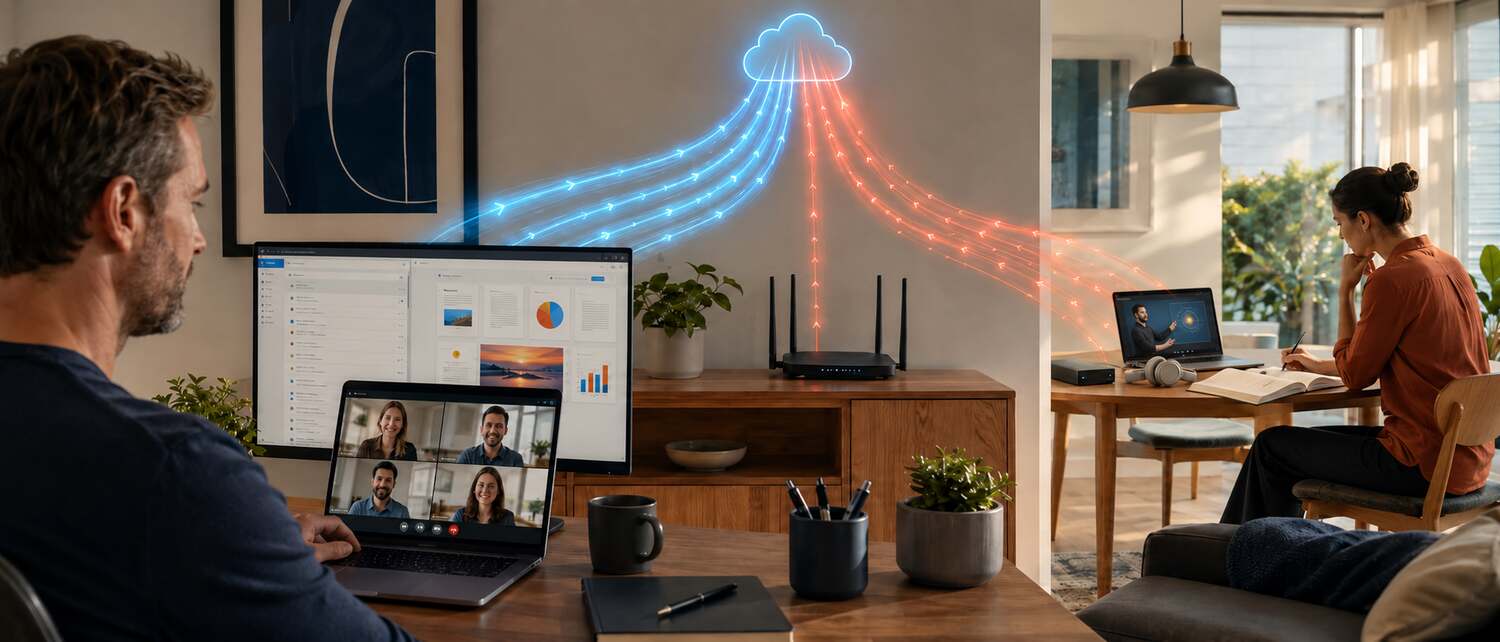
25mbps work from home bandwidth

Why Can a 25Mbps Plan Still Feel Slow?

A plan speed is only one part of the connection. The NBN connection may deliver close to the expected rate at the router while Wi-Fi loses performance across distance, walls, floors and interference. Older routers can also struggle to manage many devices, and older phones or laptops may not support newer Wi-Fi standards.

Common causes of poor performance include:

  • The router is hidden in a cupboard, placed on the floor or positioned at one end of the property.
  • Several devices are downloading updates, backing up photos or streaming without the user noticing.
  • The device is connected to a crowded 2.4GHz band when 5GHz would provide faster short-range performance.
  • The home has thick walls, multiple floors or long distances that require mesh Wi-Fi or an additional access point.
  • The test is being run over weak Wi-Fi rather than through Ethernet near the router.
  • The connection technology, internal cabling, network congestion or a fault is reducing performance.
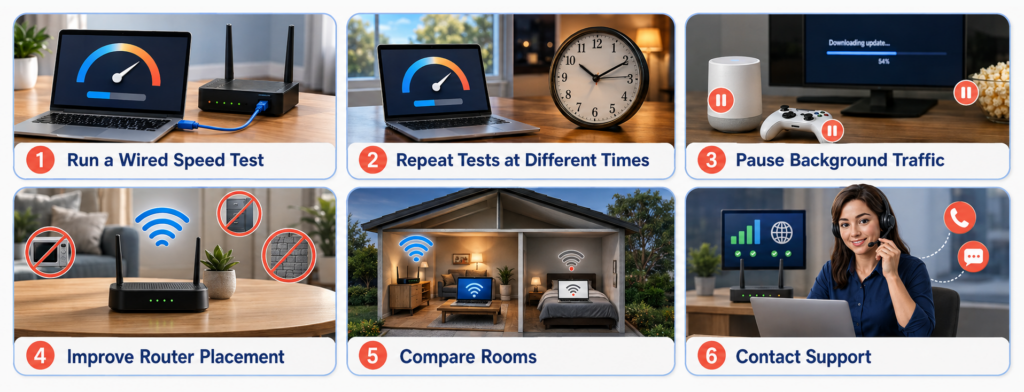
NBN recommends keeping the router in an open, raised and central location, checking device compatibility and using Ethernet when stable performance matters. A faster plan will not fix a dead Wi-Fi zone by itself. Sometimes the right upgrade is better placement, a modern router or a mesh system rather than another speed tier.
25mbps internet troubleshooting checklist

Who Should Choose 25Mbps and Who Should Upgrade?

A 25Mbps plan may be good value for a single person, a couple with moderate usage, a small apartment, a budget-conscious household or someone who mainly browses, studies, streams in HD and joins one video meeting at a time. It can also work as a practical entry tier for people who understand its limits and do not expect every device to run a heavy task simultaneously.
Consider 50Mbps or faster when the household regularly has several active users, multiple televisions, two or more remote workers, frequent 4K streaming, large console downloads, cloud backups, content uploads or smart security cameras. NBN has advised that busy households with multiple devices may need at least 50Mbps for smoother simultaneous streaming.
Simple decision rule
Choose 25Mbps when usage is moderate and usually sequential. Choose 50Mbps or faster when heavy activities regularly happen at the same time.

Occom 25Mbps NBN Plan

Occom currently lists its Boost nbn25 residential plan with 25Mbps download and 8.5Mbps upload typical evening speeds between 7pm and 11pm. The published plan includes unlimited data, $0 activation fee and customer support available 365 days a year. Pricing, promotions, router inclusions and contract terms can change, so customers should check the current Critical Information Summary and Key Facts Sheet before ordering.
The right plan still depends on the exact address and NBN technology. Some speed tiers are not available everywhere, and the speed experienced can be affected by access technology, wiring, equipment and in-home Wi-Fi. Start with an address check, compare the ongoing price rather than only an introductory offer, and match the plan to simultaneous household activity.
Final Takeaway
A 25Mbps internet speed is enough for one- and two-person Australian households. It can handle everyday browsing, social media, HD streaming, online gaming and a main work-from-home video call. It can even support one 4K stream, but the connection has little room left when other demanding activities start.
The line between “enough” and “too slow” is simultaneous use. When several people stream, call, download and upload together, 50Mbps or faster becomes the more comfortable choice. Before upgrading, test with Ethernet and check the router position, Wi-Fi coverage and background traffic. Speed matters, but a well-designed home network is what allows that speed to reach the devices that need it.
FAQ
Is 25Mbps fast internet?
25Mbps is a moderate internet speed. It is faster than a basic 12Mbps service and can support HD streaming, browsing, gaming and video calls for a small household. It is not considered high speed for a busy multi-user home, especially when several demanding activities run together.
Yes. Netflix recommends at least 15Mbps for 4K, so one 4K stream can work on a stable 25Mbps connection. Only about 10Mbps remains for every other device and background task, so buffering may occur when the household is also downloading, video calling or streaming.
It is generally enough for online gameplay. Gaming responsiveness depends more on latency, jitter, packet loss and routing than raw download speed. The limitation is download time: large games and updates can take several hours on 25Mbps.
Yes for one remote worker doing email, cloud documents and a main video meeting. Two simultaneous high-definition calls, large uploads or cloud backups may place more pressure on the connection, particularly the upload speed.
It commonly suits one or two moderate users, but there is no fixed number. Several people can browse at once, while one 4K stream can consume most of the available bandwidth. Count simultaneous heavy activities rather than connected devices.
The theoretical minimum is about 53 minutes. Real downloads normally take longer because the connection may not remain at the maximum rate and other devices, server limits and network overheads reduce the effective speed.
Choose 25Mbps for moderate use in a small household. Choose 50Mbps when multiple people regularly stream, game or join video calls at the same time. The faster tier provides more headroom and reduces the need to coordinate online activity.
Weak signal, distance, walls, interference, router placement, old equipment and background traffic can reduce Wi-Fi speed. Test with Ethernet near the router. If the wired result is healthy, improve the Wi-Fi setup rather than assuming the NBN service is faulty.
Q&A
What can a household realistically do with a 25Mbps internet connection?
A small household can browse, use social media, stream in HD, play online games and run one main video call. One 4K stream is possible, but heavy simultaneous use quickly consumes the remaining capacity.
Shared capacity. Each active device takes part of the same 25Mbps. The plan feels slow when several high-bandwidth activities overlap, even though each activity works well when used alone.
No. A faster plan helps when the household is exhausting its available bandwidth. It will not automatically fix poor router placement, weak Wi-Fi coverage, faulty cabling, device limitations, high latency or network faults.
Compare the number of simultaneous users, streaming quality, video-call frequency, download sizes, upload needs, typical evening speeds, ongoing price, NBN technology, router capability and support conditions.